
I Have Good News & Bad News
I Have Good News & Bad News
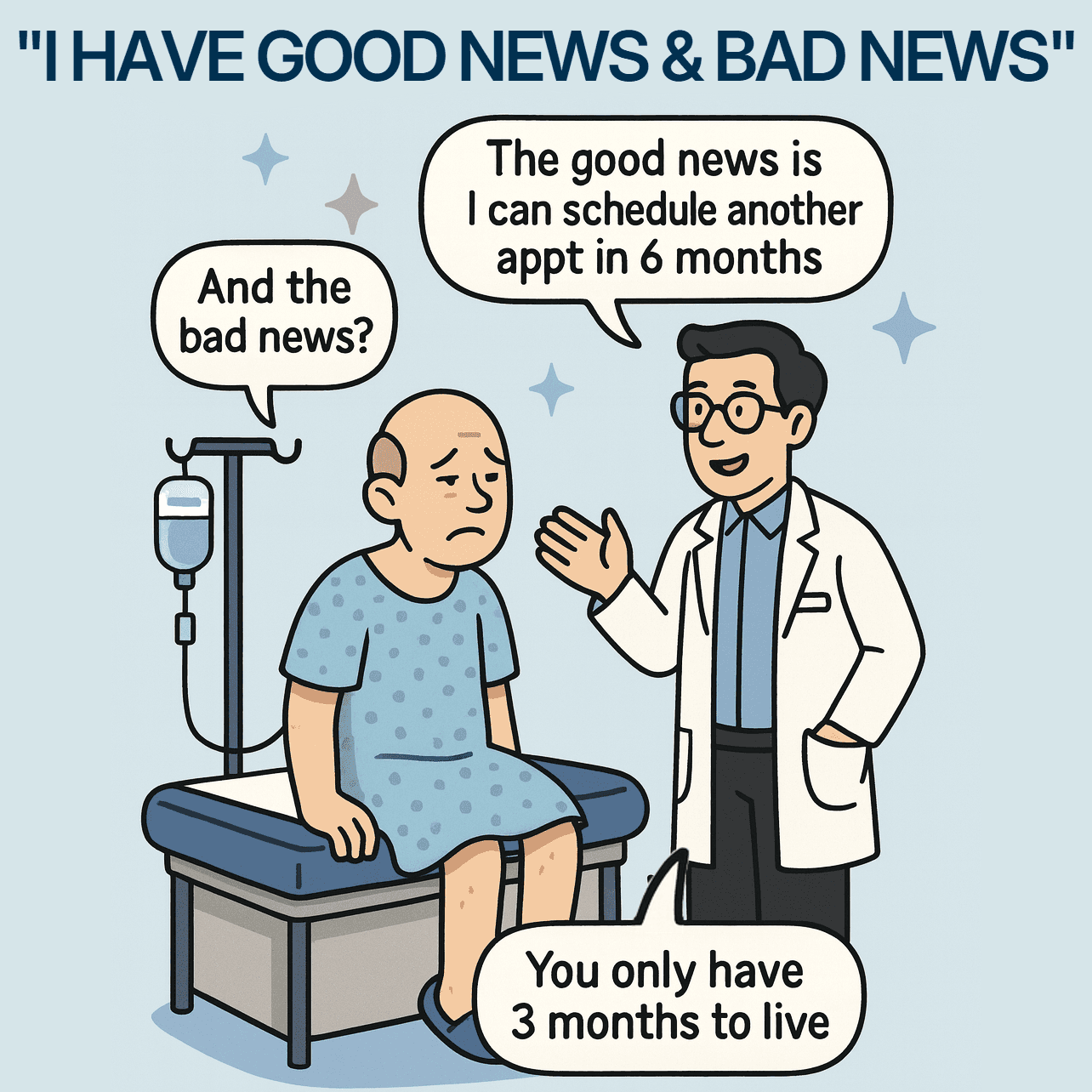
If whiplash were an emotional state, this joke would be the textbook example — the kind of medical mixed message that makes every cancer patient want to blink slowly into the void.
Let’s unpack it.
We’ve all lived through those surreal oncology conversations where the doctor’s tone is calm, measured, almost cheerful — while the content feels like getting hit by a truck.
This joke takes that emotional contradiction and dials it up to absurdity:
Good news: your next appointment is in six months!
Bad news: you won’t be here in six months!
It’s horrifying.
It’s dark.
It’s uncomfortable.
And somehow… it’s absolutely hilarious because the disconnect is so ridiculous it borders on satire.
The Core Joke
The humor lands because it exposes a real truth about cancer communication:
Doctors talk in timelines.
Patients live in them.
So when a doctor says something casual or bureaucratic — like, “Let’s schedule your next follow-up” — it doesn’t always match the emotional or existential reality the patient is dealing with.
Cancer patients are juggling:
survival timelines
treatment timelines
progression timelines
scheduling delays
waitlists
precertifications
insurance approvals
scan cycles
Meanwhile, a doctor can drop a life-altering prognosis and a scheduling update in the same breath.
Why This Joke Resonates
Because cancer patients know the absurdity of being treated like both:
a human being in crisis
and a calendar entry
at the same time.
It’s the emotional equivalent of someone saying:
“You’re on fire, but also — can you sign here?”
It’s not that doctors don’t care.
It’s that the system forces conversations to happen in a way that feels wildly mismatched to the stakes.
The Deeper Meaning
The joke shines a light on how disjointed cancer care can feel.
You’re processing:
fear
mortality
loss
identity changes
hope
grief
Meanwhile, the hospital is processing:
appointment slots
scheduling algorithms
EMR reminders
It creates this emotional absurdity where heartbreaking information and logistical updates arrive packaged together like a buy-one-get-one deal you absolutely did not ask for.
Final Thought
If you’ve ever left an appointment feeling like you heard five different realities at once…
If you’ve ever wondered why terrible news is delivered with the same tone as a weather report…
If you’ve ever felt emotionally sucker-punched by something mundane…
This joke gets it.
It captures the surreal, contradictory nature of cancer conversations — and gives us permission to laugh at the chaos, even when the news is anything but funny.
If whiplash were an emotional state, this joke would be the textbook example — the kind of medical mixed message that makes every cancer patient want to blink slowly into the void.
Let’s unpack it.
We’ve all lived through those surreal oncology conversations where the doctor’s tone is calm, measured, almost cheerful — while the content feels like getting hit by a truck.
This joke takes that emotional contradiction and dials it up to absurdity:
Good news: your next appointment is in six months!
Bad news: you won’t be here in six months!
It’s horrifying.
It’s dark.
It’s uncomfortable.
And somehow… it’s absolutely hilarious because the disconnect is so ridiculous it borders on satire.
The Core Joke
The humor lands because it exposes a real truth about cancer communication:
Doctors talk in timelines.
Patients live in them.
So when a doctor says something casual or bureaucratic — like, “Let’s schedule your next follow-up” — it doesn’t always match the emotional or existential reality the patient is dealing with.
Cancer patients are juggling:
survival timelines
treatment timelines
progression timelines
scheduling delays
waitlists
precertifications
insurance approvals
scan cycles
Meanwhile, a doctor can drop a life-altering prognosis and a scheduling update in the same breath.
Why This Joke Resonates
Because cancer patients know the absurdity of being treated like both:
a human being in crisis
and a calendar entry
at the same time.
It’s the emotional equivalent of someone saying:
“You’re on fire, but also — can you sign here?”
It’s not that doctors don’t care.
It’s that the system forces conversations to happen in a way that feels wildly mismatched to the stakes.
The Deeper Meaning
The joke shines a light on how disjointed cancer care can feel.
You’re processing:
fear
mortality
loss
identity changes
hope
grief
Meanwhile, the hospital is processing:
appointment slots
scheduling algorithms
EMR reminders
It creates this emotional absurdity where heartbreaking information and logistical updates arrive packaged together like a buy-one-get-one deal you absolutely did not ask for.
Final Thought
If you’ve ever left an appointment feeling like you heard five different realities at once…
If you’ve ever wondered why terrible news is delivered with the same tone as a weather report…
If you’ve ever felt emotionally sucker-punched by something mundane…
This joke gets it.
It captures the surreal, contradictory nature of cancer conversations — and gives us permission to laugh at the chaos, even when the news is anything but funny.
Start Your Journey
Access the support you deserve.

Start Your Journey
Access the support you deserve.
Start Your Journey
Access the support you deserve.